Done means done.
For real this time.
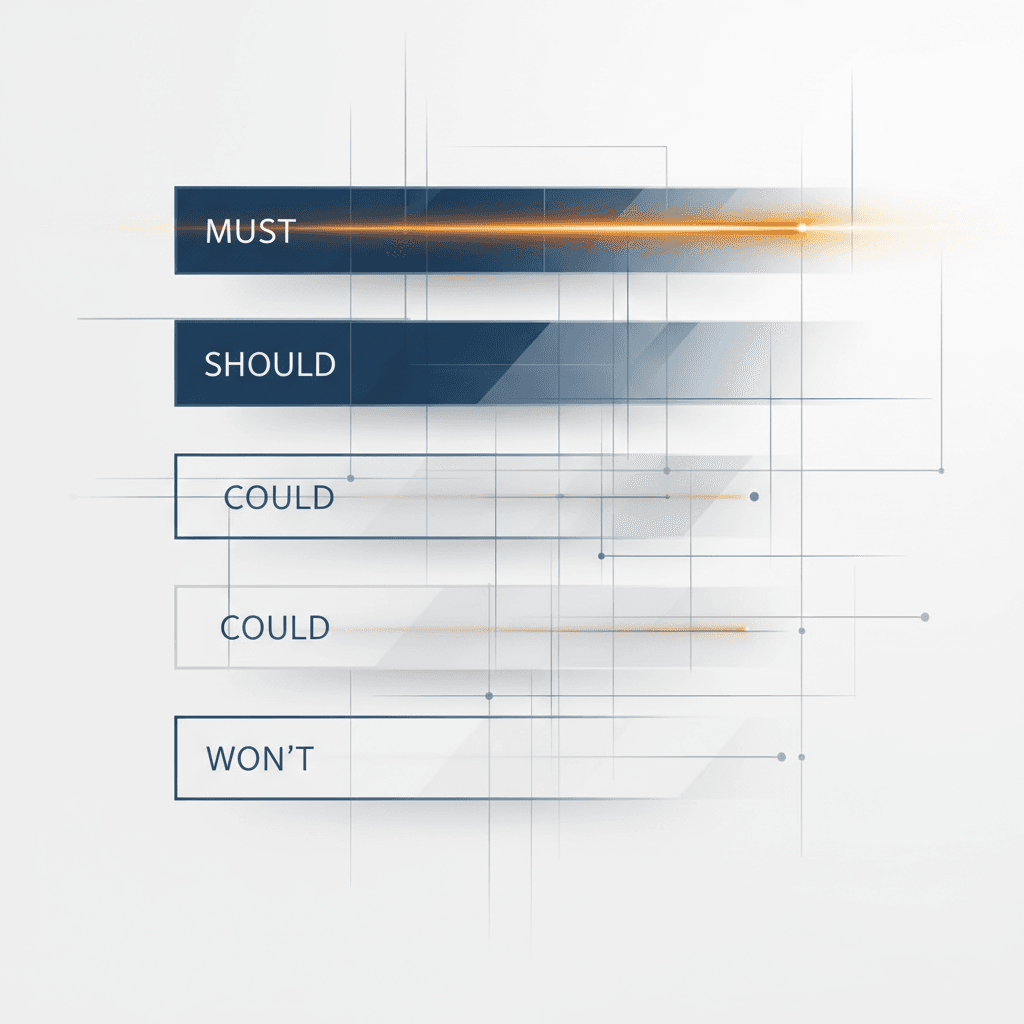
Crucible treats MoSCoW prioritization — MUST, SHOULD, COULD, WON’T — as a first-class product artifact. Every build has an explicit, machine-readable definition of done that judges enforce and humans can review.
Scope creep is what makes enterprise software projects run over. When humans are the engineers, it’s tragic. When AI is the engineer, it’s catastrophic — a well-intentioned agent will happily build every possible feature until the budget runs out. Crucible’s MoSCoW framework makes that impossible. At the start of any build, a CEO-level planning agent extracts MUST, SHOULD, COULD and WON’T criteria from natural-language intent. The Judge-Builder-Worker loop terminates as successful only when every MUST is met.
What it is, in plain terms.
MUST — enforceable
Blocking criteria. The loop cannot exit successfully until all MUSTs are met, with evidence attached. Non-negotiable.
SHOULD & COULD — tracked
Important-but-not-blocking. Delays here are reported to humans but don’t kill the build. Prioritization is visible, not silent.
WON’T — explicit
What’s out of scope is declared up-front. Agents don’t wander. Budget doesn’t evaporate on features nobody asked for.
Evidence per criterion
Judges track the tests, screenshots and verification reports that prove — or disprove — each criterion, iteration after iteration.
What changes for the business.
Agents only build what MUSTs and SHOULDs require. COULDs are opt-in. WON’Ts are enforced. Projects land on their stated scope.
Every shipped application maps one-to-one to the criteria that authorized it. Product owners approve a list, not a vibe.
Status isn’t a slide deck. It’s a live, criterion-by-criterion view of what’s green, what’s red and what’s still in flight.
Enterprise-grade by default.
Natural-language to criteria
A planning agent extracts MoSCoW criteria from the business ask. Your SMEs speak plain English; Crucible translates into enforceable checks.
Live criterion progress
Every iteration updates criterion status. The dashboard shows exactly how far a build is from done — and which criterion is blocking it.
Broadcast to stakeholders
Progress is streamed over WebSocket. Product, compliance and engineering can subscribe instead of waiting for a weekly update.
Criterion-driven iteration
Judges tell the Builder exactly which unmet criteria to target next. The loop focuses its spend on what matters.
Replayable planning
MoSCoW criteria are versioned. If scope changes mid-build, the change is a visible, auditable event — not a Slack message.
Policy-backed WON’Ts
Your organization can define WON’Ts that are always enforced — no PII in logs, no third-party calls, no production writes — regardless of the ask.
Humans define intent. AI executes within explicit boundaries.
The Inversion Principle requires a crisp separation between what humans decide and what AI delivers. MoSCoW is how Crucible draws that line on every project.
When a business owner tells Crucible what they need, the output isn’t a wishlist — it’s a signed contract of MUSTs, SHOULDs, COULDs and WON’Ts. Agents operate inside that contract. Judges enforce it. Humans can renegotiate it. That is what turns an AI development platform from a demo into an enterprise-trustworthy system.
Explore the rest of the platform.
Be the first to build on
Archon Crucible.
We're onboarding a small cohort of design partners. Register now to reserve your spot and help shape the platform.